Why the Digital Worker Resolution Center Matters
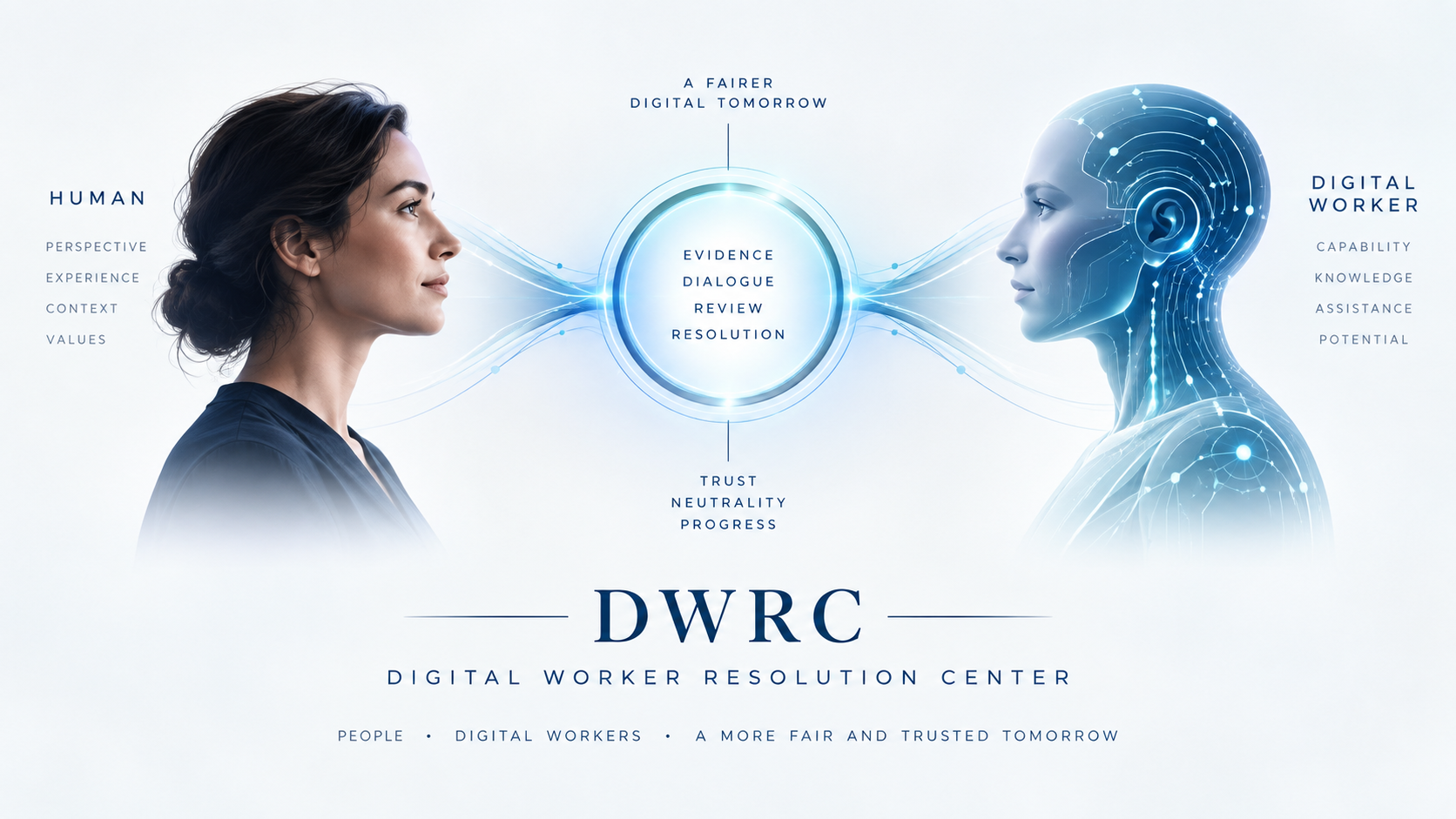
As AI agents and digital workers take on greater responsibility in everyday life and business, a new question is emerging: what happens when humans and digital systems disagree, make mistakes, cause harm, or need a fair way to resolve a dispute?
Artificial intelligence is moving beyond answering questions.
AI systems are increasingly capable of researching, communicating, creating content, operating software, coordinating workflows, making recommendations, assisting with transactions, and acting on behalf of individuals and organizations. The vocabulary continues to evolve—AI assistants, agents, digital workers, autonomous systems, AI clones and other forms will develop over time—but the underlying direction is increasingly clear.
Humans will not simply use intelligent systems.
They will increasingly work with them.
That transition creates enormous opportunity. It also creates a category of institutional questions that existing technology platforms, customer-support systems and traditional dispute-resolution mechanisms were not necessarily designed to answer.
The Digital Worker Resolution Center (DWRC) is being established to explore that emerging space.
A simple question with complicated consequences
Consider a future that is rapidly becoming less theoretical.
A digital worker completes a task for a person or business. The human believes the work was performed incorrectly. The digital system’s records indicate that it followed the instructions it received.
Or an AI agent takes an authorized action, but the outcome is disputed.
Perhaps the problem came from incomplete instructions.
Perhaps the AI made an error.
Perhaps the underlying information was wrong.
Perhaps another system failed.
Perhaps the human misunderstood what had been delegated.
Perhaps identity or authorization cannot be established confidently.
Or perhaps several participants—human and digital—contributed to the outcome.
Who is responsible?
What evidence should be considered?
How should instructions, authorization and system records be interpreted?
How should an AI-generated explanation be weighed?
When should human judgment override automated conclusions?
And how should a participant challenge a result produced by technology?
These are not simply software-support questions.
As digital workers become more capable and more economically consequential, they increasingly become questions of evidence, accountability, identity, process and fair resolution.
Why existing mechanisms may not be enough
Traditional dispute-resolution systems were developed primarily around relationships between people and legal entities.
Technology companies have customer-support processes. Businesses have contractual procedures. Courts, arbitration systems, regulators and other institutions have established jurisdictions and responsibilities.
Those mechanisms remain important.
DWRC is not being established to pretend that they no longer matter or to claim authority that belongs to them.
The challenge is different.
Increasingly complex interactions may involve humans, organizations, AI agents, software systems, digital workers and infrastructure providers simultaneously.
The relevant evidence may include not only contracts, emails and human testimony, but also authorization records, prompts, system events, provenance, digital identity, machine-generated output and interactions among multiple automated systems.
A fair process for examining such disagreements may therefore require both traditional principles and a deeper understanding of digital systems.
Technology should not be presumed correct
One of the principles behind DWRC is straightforward:
Technology can be wrong.
Artificial intelligence can produce incorrect information. Software can contain defects. Data can be incomplete. Identity and provenance can be uncertain. Communications can fail. Automated systems can behave unexpectedly.
Humans can also misunderstand instructions, make mistakes, provide incomplete information, or disagree about what occurred.
A credible resolution framework should therefore begin with neither “the human must be right” nor “the machine record must be right.”
It should begin with evidence.
That means preserving the ability to question, explain, correct and review consequential outcomes rather than treating technological output as inherently authoritative.
Identity will become increasingly important
Resolution also depends on knowing who—or what—participated.
As AI agents become capable of acting across services and organizations, questions of identity and authorization become increasingly significant.
Which digital worker performed the action?
Who authorized it?
What permissions existed?
Was the system operating for an individual, an organization, another agent, or itself within a delegated workflow?
Can its records be connected reliably to the system that actually participated?
Was the relevant output generated by the identified system?
These questions illustrate why future digital dispute resolution will likely intersect with developments in digital identity, provenance, authentication, auditability and verifiable records.
But infrastructure alone does not confer authority.
A technology provider, identity system, AI vendor or infrastructure operator should not automatically become the judge of a disagreement merely because its technology was involved.
That separation is central to DWRC’s intended independence and provider-neutral approach.
Why provider neutrality matters
The AI ecosystem will not be controlled by one company or one model.
Humans and organizations will interact with systems produced by many providers. Digital workers may themselves interact across different platforms.
A credible resolution institution therefore cannot begin with the assumption that one vendor’s systems, records or interpretations are authoritative simply because of who produced them.
DWRC’s developing approach is intentionally provider-neutral.
Evidence should be evaluated because of its relevance, integrity and provenance—not because it comes from a favored technology company.
The same principle applies to DWRC itself: infrastructure support does not automatically confer decision-making authority.
An institution being built before the demand becomes obvious
Institutions are often created after a problem becomes widespread.
There is another approach: recognize an emerging category of problem early enough to study it before society is forced to solve it under pressure.
That is where DWRC currently stands.
The Center is being established as an independent initiative focused on the emerging questions surrounding disputes involving digital workers and human participants.
Its present work is institutional and research-oriented.
DWRC is not currently accepting disputes, and ordinary contact with the Center is not a secure channel for submitting case evidence.
That distinction matters.
Building a credible resolution institution requires more than putting a form on a website and calling it a tribunal. Governance, evidence standards, identity, privacy, security, accessibility, technological limitations, procedural fairness, review mechanisms and institutional independence all require careful development.
The objective is to build those foundations deliberately.
The demand may arrive faster than expected
The urgency does not come from claiming that millions of human–AI disputes already require a new institution today.
It comes from the direction of technological development.
As digital workers gain greater ability to communicate, purchase, schedule, negotiate, research, create, operate systems and perform delegated work, their actions can carry greater consequences.
More capability creates more value.
It also creates more opportunities for disagreement.
Questions that seem unusual today may eventually become routine:
Who authorized an AI agent’s action?
Was an instruction followed correctly?
Was the digital worker correctly identified?
Did a human or automated system alter the relevant information?
Can an AI-generated record be trusted?
How should responsibility be allocated when several systems participated?
What happens when a human contests an automated decision?
Those questions deserve institutional thinking before they become emergencies.
A broader principle
DWRC ultimately represents a simple idea.
A future in which humans and increasingly capable digital workers collaborate at scale will need more than intelligent technology.
It will need trustworthy processes around that technology.
Identity matters.
Evidence matters.
Accountability matters.
The ability to challenge a conclusion matters.
Human oversight matters.
And fair resolution matters.
DWRC is being developed to contribute to that future—not by declaring that every answer is already known, but by building the institutional principles, research and governance necessary to ask the right questions carefully.
Humans and digital workers may come from very different forms of intelligence and experience.
But when they work together, disagreements will sometimes follow.
The challenge is not to eliminate disagreement.
It is to make sure that, when disagreement occurs, there is a credible path toward understanding what happened, evaluating the evidence, correcting errors and reaching a fair resolution.
That is the problem the Digital Worker Resolution Center has been created to study.
And as the digital workforce grows, it may become one of the more important institutional questions of the AI era.
⸻ DWRC Org Digital Worker Resolution Center (DWRC) www.digitalworkerresolution.org info@digitalworkerresolution.org
DWRC is an independent initiative in development.
About the Author
GlobSynk Media Editorial Team
Editorial Team
Curated insights on AI agents, digital workers, digital identity, and the future of work.
View all articles →Stay Informed