Humans, AI Agents and Automation: A Practical Model for the Digital Workforce

Most organizations now run on three different kinds of work at once: people making judgment calls, AI agents handling bounded tasks that require some interpretation, and traditional automation quietly executing rules that never change. Treating all three as one thing — or assuming AI agents should simply replace the other two — is where many digital workforce plans go wrong.
THREE KINDS OF WORK IN ONE OPERATING MODEL
A useful way to think about a modern digital workforce is as three layers working together, not as a ladder where AI eventually replaces everything below it.
What humans do best
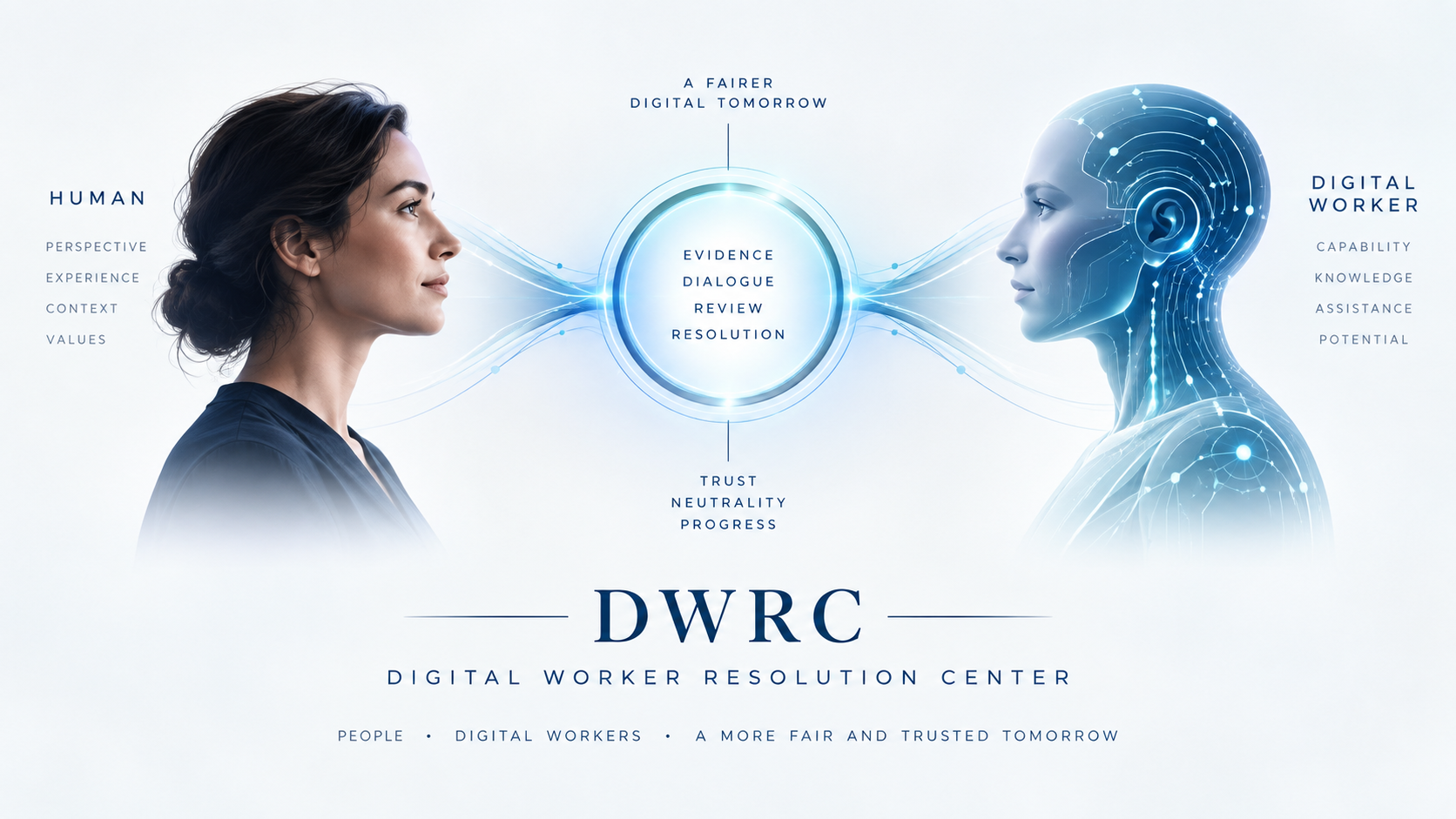
People remain essential for judgment, accountability, relationships, values, exception handling and strategic decisions. A human is the one who decides what the organization is willing to do, who takes responsibility when something goes wrong, and who handles the case nobody wrote a rule for. None of that disappears because software gets more capable — if anything, it becomes more important as more routine work moves elsewhere.
Where AI agents fit
An AI agent is software capable of performing a bounded task with some degree of reasoning, tool use or adaptive decision-making, operating under authority someone else defined. That's a meaningfully different thing from a script.
An agent is useful when a task requires interpreting something that varies — a customer's phrasing, a document's structure, which of several tools or data sources actually applies — and the next action genuinely depends on what it finds, not on a fixed sequence written in advance.
Where automation still wins
Deterministic automation is still the right answer for a large share of real work, and treating it as something to be replaced is a mistake.
Where rules are stable, inputs are predictable, repeatability matters more than reasoning, and cost or latency matter, a traditional workflow can be the better tool: it is generally more predictable and produces the same result when given the same defined inputs.
Routing a support ticket to the right queue, validating a required field, or running a scheduled reconciliation process does not necessarily need reasoning. It needs to happen according to a known rule. Adding an agent to a job like that can add unnecessary variability to something that was already reliable.
WHY AI AGENTS SHOULD NOT REPLACE EVERY WORKFLOW
The instinct to point an AI agent at every process is understandable, but it gets the trade-off backwards.
Agents are useful specifically where interpretation is required — where a fixed rule cannot capture what the task actually needs. Deploying one where deterministic automation already works well can mean adding cost, latency and a wider range of possible outcomes to a problem that was already solved.
Organizations can get more value from AI agents when they are equally disciplined about where not to use them.
HOW THE HANDOFFS WORK
In practice, work moves between these three layers rather than sitting permanently in one.
Automation can handle intake — validating that a request is well formed, capturing it and routing it.
An AI agent can take over when the next step depends on understanding the specific request: what is being asked, what information applies and what a reasonable next action looks like.
A human takes over when the case is sensitive, ambiguous, high-stakes or outside what the agent has been given authority to decide.
A well-designed system makes those handoffs explicit rather than accidental. Everyone — and every system — involved should have a defined role, defined authority and a clear path for escalation when uncertainty appears.
An AI agent should not be expected to improvise beyond its authority. When the system cannot establish an appropriate next action with sufficient confidence or within its defined boundaries, escalation to a human or another governed process should be available.
A PRACTICAL EXAMPLE
Customer support is a familiar process that makes the model concrete.
Automation handles intake: it validates fields on an incoming request, checks required information, creates the ticket and routes it by type.
An AI agent can then interpret the request, search an organization's approved knowledge sources and either help resolve a routine issue or prepare a clear next step.
A human handles the cases that require human judgment: sensitive situations, complaints, policy exceptions, unusual circumstances or issues the agent identifies as outside its authority.
None of the three layers is doing the others' job. Each is handling the part it is better suited for, and the handoffs between them are defined rather than improvised.
ACCOUNTABILITY STILL BELONGS SOMEWHERE
None of this works if accountability becomes vague.
An AI agent is not an independent organizational authority merely because it can perform tasks. It operates within permissions and boundaries established by people and organizations.
Organizations still need humans responsible for setting that authority, defining what an agent may do on its own, reviewing decisions that carry significant consequences, handling exceptions and monitoring outcomes over time.
Capability can move into software without organizational responsibility disappearing with it.
STARTING SMALL
This is an architectural principle, not a company-size requirement.
A small business and a large enterprise are answering the same fundamental question at different scales: which parts of a process require judgment, which require adaptive interpretation, and which are best handled by repeatable rules?
A practical starting point is to choose one process.
Identify the steps that are already predictable enough for automation.
Identify the parts that genuinely require interpretation.
Define where human approval or intervention remains necessary.
Only then decide whether an AI agent earns a place in the sequence.
That approach is usually more useful than starting with the question, "Where can we add AI?"
THE DIGITAL WORKFORCE IS A SYSTEM, NOT A REPLACEMENT STRATEGY
The organizations that benefit most from this shift may not be the ones that deploy the largest number of agents. The stronger model is a coherent system in which humans, AI agents and deterministic automation each handle the work they are suited for, with clear ownership of the handoffs between them.
For a broader look at the shift itself, see "The Future of the Digital Workforce" at https://media.globsynk.ai/future-of-the-digital-workforce.
GlobSynk is a U.S.-based technology and innovation company building digital workforce infrastructure and AI-enabled products for people and organizations. That focus includes how human judgment, AI-agent capability and automation can operate together as parts of a governed system.
About the Author
GlobSynk Media Editorial Team
Editorial Team
Curated insights on AI agents, digital workers, digital identity, and the future of work.
View all articles →Stay Informed